Newsletters, Blog Posts, and Podcasts

Welcome to a new edition of the Famous Interviews with Joe Dimino series .. On this episode, we talk with Italy-based Book Coach Barbara Boyd .. She coaches writers in non-fiction and memoir. A nurturer and consummate organizer, Barbara helps writers clarify and express their ideas while advocating for the reader. She has collaborated on more than two hundred books in various roles of book coach, developmental editor, executive editor, and ghostwriter on topics that include leadership, health, self-help, finance, and memoir. Under her own name, she’s authored a dozen books for the For Dummies, Complete Idiot’s Guide, and Teach Yourself Visually series. Barbara believes everyone has a book to write—you need only ask the right questions. We get into so much. Enjoy this Interview.

Abigail is joined by nonfiction book coach expert, Barbara Boyd, to analyze James Clear's nonfiction book (a personal growth book) phenomenon, ATOMIC HABITS. What makes this deep dive particularly interesting is that Barbara and Abigail decide to analyze not the first chapter, but the introduction—something Barbara explains is crucial for a nonfiction book and book proposal that hooks a literary agent (and target readers).

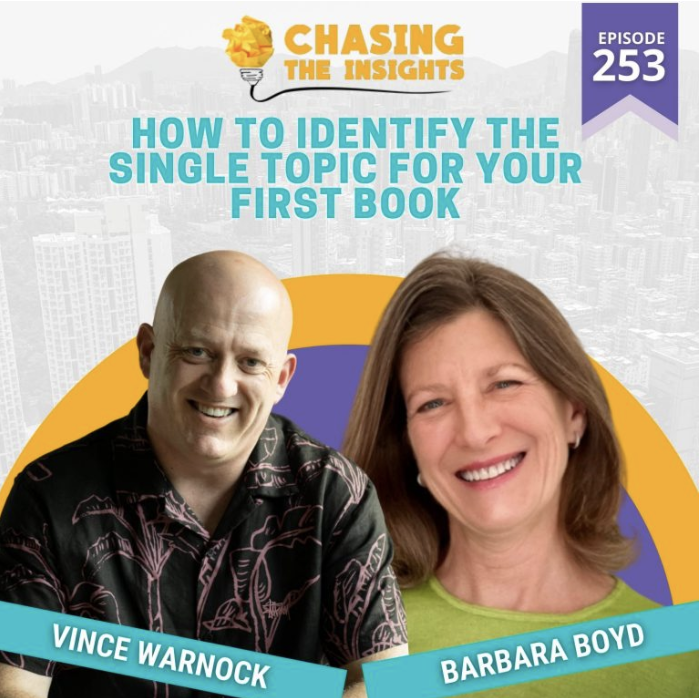
In this episode of Chasing the Insights, I talk to author and certified book coach Barbara Boyd.
Barbara talks to us about how to identify the single topic for our first book.

This is the last episode in the 10-part Blueprint for a Book Series. Start with Step 1, do the work (we’ll give you an assignment every week), and in 10 weeks, you’ll have a solid foundation for a first draft or revision of your project that will help you push through to “the end”.

Experts have so much information but so little space in a book.
How can they determine what information should be in a book?
Why you must have an outline?
I talk with Dan Janal about the three questions you need to ask before you write your first word.

Barbara Boyd says on her website that a book coach is a combination of “an editor, a project manager, a mentor, and an honest BFF … [providing] editorial feedback, emotional support, and project management and accountability.” In my conversation with her, she was extraordinarily sensitive, intelligent, and articulate. I concentrated on her work with people who are writing memoirs. It was really a fascinating interview of a person whose centredness and empathy I could sense on Zoom all the way from her olive farm in Italy to my condo in Canada. Please listen.

She began as a reader on the bookmobile in her small New Jersey town. Her next chapter was as a writer, but these days she lives on an olive farm in Italy, and she’s back to reading in her role as a coach, guiding authors through the process of writing their own books.

A creative cohort who writes for a sports publication identified three phases of coaching that he sees with athletes: nurturer, guide, and tough love. The same three phases apply to book coaches — and gardeners. I split my time between book coaching and olive gardening; let’s take a look at each.






I am working with book coach Barbara Boyd on my forthcoming book, Blueprint for a Memoir and on another book that I keep referring to as the book book, even though it has a working title. I’m just reluctant to share it yet because I feel superstitious about it—like if I utter it, someone will steal it. This is truly silly, I know, but it’s what I feel. I am very attached to my working title, and there is a lot that hangs on it, so it shall be known here as the book book—a book about books. I spoke here about my decision to work with a book coach after thinking that I didn’t need one and quickly learning how very wrong I was. I was smarter this time around.